_edited.png)
The Basics Surrounding SIPs & Thinking Ahead

Updated: Jan 1
Structural Insulated Panels (SIPs) are a building system that has "officially" been around since the 1950s. The first proper SIP home was built by architect and student of Frank Lloyd Wright, Alden B. Dow. You can trace the idea of SIPs as far back as the 1930s when Forest Products Laboratory in Madison, Wisconsin engineered Stressed-Skin Panels (SSP) through their advance structure and composite research. The only major difference between SIPs and SSPs, is that SIPs are structural in nature and have become the industry standard when speaking about this particular building system. While there are several nuances in building panels, for the sake of this blog post: Potato, potahto - assume structural and self supporting in nature.

A SIP itself looks similar to an ice cream sandwich. A continuous foam core in-between two structural boards, which is typically made out of, but not limited to OSB (oriented strand board). Unlike insulation that is situated between framing studs, this continuous foam core is what reduces thermal bridging and leads to a more energy efficient home. In simple terms, thermal bridging is a weak point in a building's envelope that allows heat to follow the path of least resistance - which leads to loss of energy across the thermal bridge.
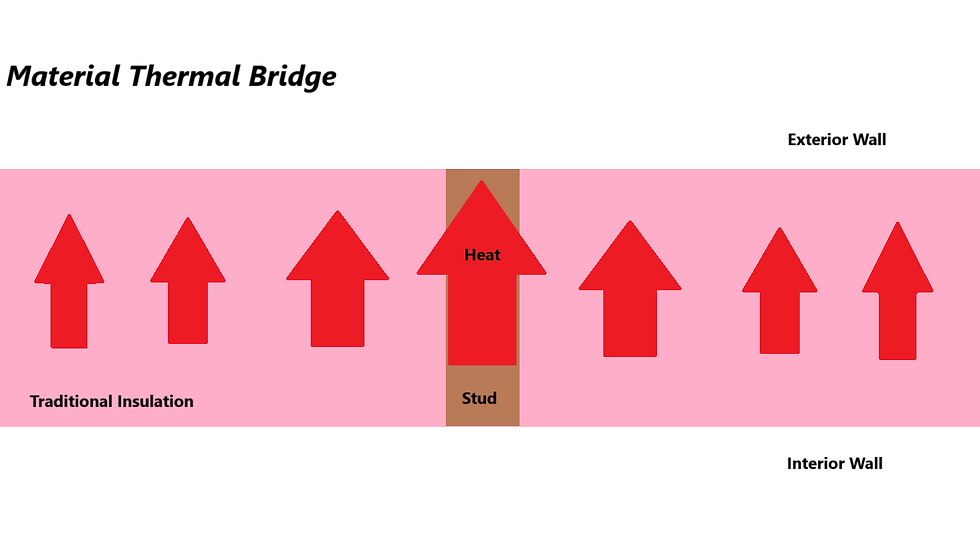
Reducing the thermal bridge, insulating, and regulating temperature are the most important parts of an energy efficient home and they all go hand-in-hand. This is done with SIPs by creating an air-tight envelope. An airtight envelope is just a term to say that the walls are joined and sealed so there are no gaps where air or moisture can enter. This way, homes and structures stay warm during the winter months, and keeps the warm air out during the summer.
SIPS offer incredible insulation, which usually starts a discussion on "R-Value". R-value broken down is simply the measurement of the insulation's ability to resist heat. Some may refer to it insulating power. It is calculated by dividing the thickness of a material by its thermal conductivity. The HIGHER the R-value the BETTER the insulation. When building a home, you want your walls, floors, and roof to have high R-values to maximize energy efficiency, because that lowers the demand of energy (your utilities: heating and cooling), which reduces costs.

The continuous foam can be made out of number of materials: Expanded polystyrene (ESP), Extruded polystyrene (XPS), and Polyurethane foam (PUR).
All of these components are then pressure-laminated in a factory and when put together a SIP panel is formed...similar to an I-beam, where the facings act as the flanges and the core is the web.

All of the elements of the SIP are stressed. The transverse and axial loads keep the OSB skins in tension and compression, while the core resists shear and buckling.
The strength of these SIPs is just one of many added benefits to the insulation aspect. SIPs have a lineage of testing to prove that they are over twice as strong as traditional stick frame building systems. The test are linked, but there's real world proof. Trees have fallen on SIP homes and the structures remained fully intact. Testaments against hurricanes, earthquakes, tornadoes, and protection from severe elements. In 1992, after Hurricane Andrew devastated southeastern Florida, the Federal Emergency Management Agency (FEMA) issued a statement regarding modular housing that it,
"...provided an inherently rigid system that performed much better than conventional residential framing."
Outside of structural integrity and insulation, SIPs provide cleaner air quality inside of a home. While the homeowner may see a variety of benefits, including lower utility costs, the builders do as well. SIPs are manufactured in controlled factory settings allowing:
Materials to be purchased in bulk, saving shipping and product costs
Design software and machinery making precise cuts for exact measurements and squaring
Many SIPs are delivered ready to assemble which can lower the chance of materials being damaged by the elements on a worksite
Less labor involved in framing
Drastic cutbacks on jobsite waste
Overall quicker assembly
For the sake of green building initiatives:
High R value
Limited waste
OSB is typically sourced from a variety of soft wood. These softer woods are harvested from younger, fast growing trees, which allows older forests to grow untouched.
Significantly improved indoor home air quality
Less lumber used in home construction
Overall high performance air tight envelope reducing energy demand, in some cases up to 80% less energy usage
With the housing shortage and seemingly intensifying weather, labor shortages, supply chain conflicts, and cost of materials, SIPs are a building system that is becoming the norm. SIP manufacturers have seen a steep increase in demand both in the US and abroad. SIP panels have forced the residential building industry to rethink how we see energy performance and it's already happening - dare I say the beloved ZIP system came to fruition through the concept of SIPs...
While the advancement of technology and rise of AI is something we should take advantage of to mitigate some of these challenges (like an airtight building envelope) we cannot lose focus of how to build an intentional home. As a society we have gone to great lengths to digitize our lives from personalities, lifestyle, intimate moments, experiences, fashion, and sources of dopamine - are we really better off? Now is the time to find balance between keeping traditional principles and craftsmanship in homebuilding while adjusting to our new normal.
A non-traditional building system doesn't mean it's bad, it's simply different.


Comments